

SAP Build and Integration Suite
Building the Foundation of the Autonomous Enterprise
Digital transformation is entering a new phase. Organizations are no longer looking only to connect systems. They want software that can understand business goals, automate work, and help teams make better decisions with less manual effort.
This shift is driving the move toward the Autonomous Enterprise.
At the center of this transformation is SAP Build and SAP Integration Suite, working together on SAP Business Technology Platform (SAP BTP). Together, they help organizations design applications faster, automate business processes, connect enterprise systems, and introduce AI into everyday operations.
For companies investing in SAP modernization, understanding how SAP Build and Integrate work together is becoming essential for future growth.
Why Integration Matters More Than Ever
Every organization depends on information flowing across departments.
Sales needs customer data.
Finance needs purchasing information.
Supply chain teams need inventory updates.
HR requires employee data.
When these systems operate independently, businesses experience delays, duplicate work, reporting errors, and higher operating costs.
Traditional integration solved only part of the problem by moving data between systems.
Modern organizations need something much more powerful.
They need platforms that can understand business intent, coordinate workflows, support AI agents, and securely manage enterprise data across cloud and on-premise environments.
This is exactly where SAP Integration Suite delivers value.
The Four Pillars of SAP BTP: Building the Autonomous Enterprise
SAP Business Technology Platform (SAP BTP) is more than a collection of services. It is the foundation that enables organizations to build intelligent applications, connect business systems, manage enterprise data, and introduce AI into everyday operations.
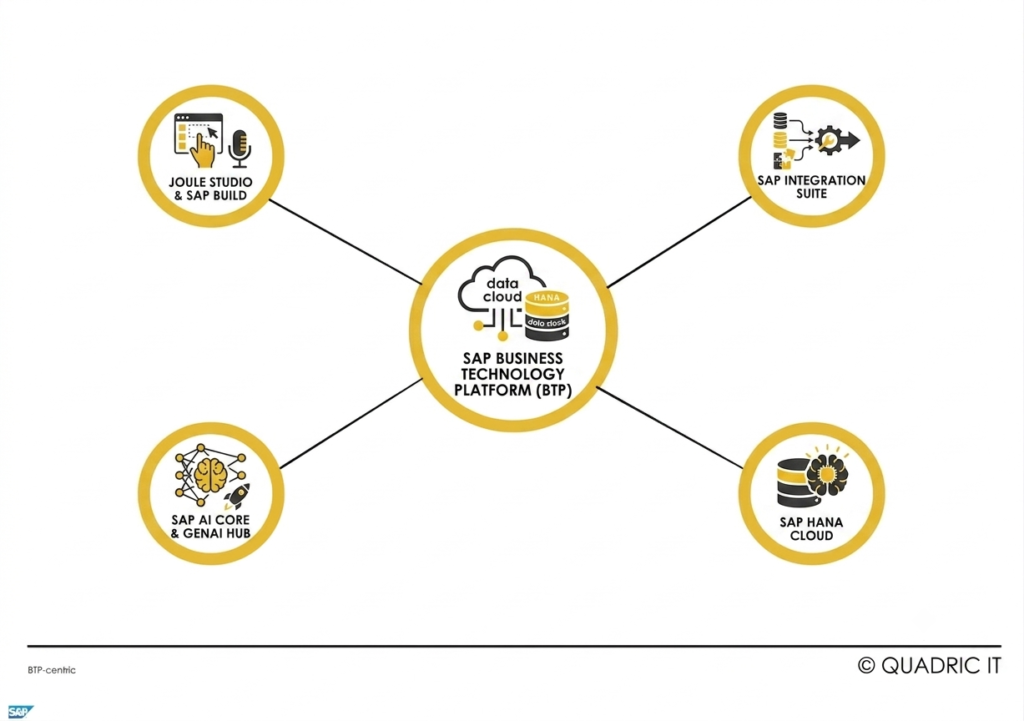
At the heart of SAP’s autonomous enterprise strategy are four closely connected capabilities.
1. SAP Build and Joule Studio
SAP Build, together with Joule Studio, helps organizations create applications, automate workflows, and develop AI-powered business solutions using low-code and no-code tools. Business users and developers can turn ideas into working solutions faster by describing business requirements in natural language.
2. SAP Integration Suite
SAP Integration Suite connects SAP and third-party applications across cloud, on-premise, and hybrid environments. It automates business processes, manages APIs, supports event-driven architecture, and provides the integration layer required for enterprise-wide AI initiatives.
3. SAP AI Core and Generative AI Hub
These services provide the enterprise AI foundation for developing, deploying, and managing AI models securely. They allow organizations to build intelligent business applications while maintaining governance, compliance, and centralized AI management.
4. SAP HANA Cloud
SAP HANA Cloud serves as the intelligent data platform for SAP BTP. By bringing together business data from across the enterprise, it provides the context that AI applications and autonomous workflows need to deliver accurate recommendations, automate decisions, and support real-time business operations.
Together, these four pillars create a unified platform where applications, integrations, data, and AI work as one. Instead of managing disconnected technologies, organizations can build an intelligent enterprise that is ready to scale, adapt, and innovate.
From SAP CPI to SAP Integration Suite
Many SAP customers are familiar with SAP Cloud Platform Integration (CPI), which became the standard solution for connecting SAP and third-party applications.
Today, SAP Integration Suite goes far beyond what SAP CPI originally offered.
When comparing SAP Integration Suite vs. CPI, the difference is not simply new features. It represents a completely different approach to enterprise integration.
SAP Integration Suite provides:
-
- Enterprise-wide application integration
-
- API management
-
- Event-driven architecture
-
- Integration assessment tools
-
- B2B integration
-
- AI-enabled workflow orchestration
-
- Central governance across hybrid and multi-cloud environments
Instead of acting as a collection of integration flows, the platform becomes an enterprise integration backbone capable of supporting intelligent automation at scale.
SAP Integration Suite vs. CPI
For many organizations modernizing their SAP landscape, one of the first questions is understanding the difference between SAP Integration Suite and SAP Cloud Platform Integration (CPI).
While SAP CPI focused primarily on connecting applications across cloud and on-premise environments, today’s SAP Integration Suite has evolved into a comprehensive integration and automation platform. It not only connects systems but also manages APIs, orchestrates business processes, supports AI-powered workflows, and provides centralized governance across the enterprise.
This evolution reflects a broader shift in enterprise software. Instead of building integrations line by line, organizations can now adopt intent-based development. Business users or developers describe the desired outcome in natural language, while SAP Build, Joule, and AI-powered services help generate applications, workflows, and integration logic that accelerate implementation.
By combining intelligent automation with enterprise governance, SAP Integration Suite enables organizations to move beyond traditional integration and lay the foundation for an Autonomous Enterprise.
Understanding the SAP Integration Suite Architecture
The latest SAP Integration Suite architecture has been designed for organizations adopting AI across business operations.
Rather than focusing only on moving data from one application to another, the platform coordinates data, applications, workflows, and AI agents through a secure governance model.
Some of the most important innovations include:
Joule Studio
Joule Studio provides an AI-first development environment where business users and developers can describe requirements using natural language.
Instead of writing everything manually, users define business intent while AI assists with application design, workflow creation, and automation.
SAP AI Agent Hub
As organizations deploy multiple AI agents across departments, governance becomes increasingly important.
SAP AI Agent Hub acts as a central location to discover, manage, monitor, and securely govern enterprise AI agents throughout their lifecycle.
Model Context Protocol (MCP)
The introduction of the Model Context Protocol (MCP) allows enterprise services and business knowledge to connect directly with modern development tools such as Visual Studio Code.
Developers can build applications with richer business context while reducing manual integration effort.
Together, these capabilities allow organizations to introduce autonomous workflows without sacrificing security, governance, or compliance.
SAP Build and Integrate: From Business Idea to Working Solution
One of the biggest changes introduced by SAP is the move from traditional software development toward intent-driven development.
Rather than spending weeks creating technical specifications before development begins, business users can describe objectives while AI helps generate the required technical artifacts.
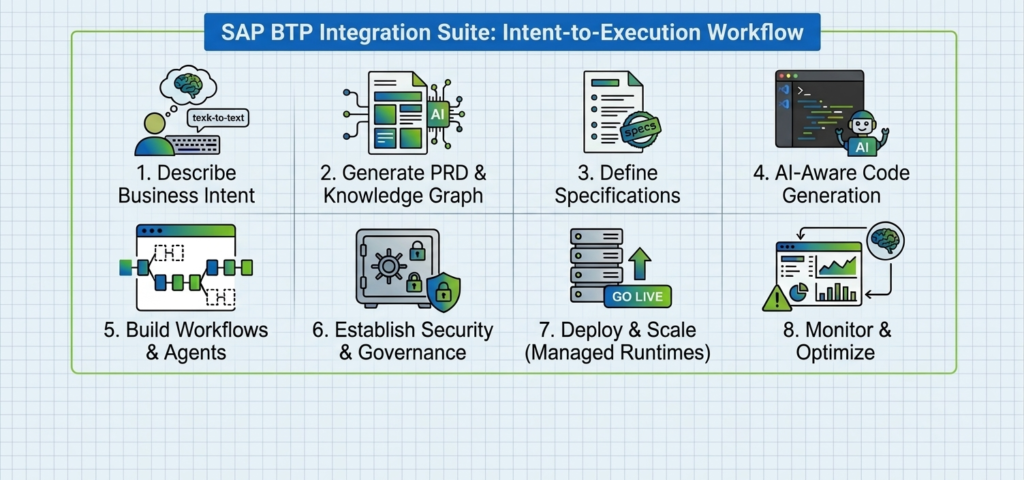
A typical SAP Build and Integrate workflow looks like this.
Step 1: Analyze Business Intent
Users describe the business problem in plain language.
For example:
“Automatically adjust inventory levels when international tariffs change.”
The platform interprets the objective and identifies relevant business processes.
Step 2: Generate the Product Requirements Document (PRD)
Using SAP’s business knowledge and enterprise context, the platform automatically creates a structured Product Requirements Document.
The PRD includes:
-
- Business goals
-
- User stories
-
- Success criteria
-
- Process scope
-
- Functional requirements
This reduces documentation effort while improving consistency.
Step 3: Create Technical Specifications
The generated requirements are converted into implementation specifications that AI agents can execute.
Developers spend less time translating business language into technical documentation.
Step 4: Generate Applications, Integrations, and Code
SAP-aware AI generates application components, workflows, integration logic, and deployment-ready code.
These assets can be deployed directly into Git repositories and existing CI/CD pipelines.
Instead of manually building every integration, developers review, refine, and extend AI-generated solutions.
The result is faster delivery, improved consistency, and reduced development effort.
Choosing the Right SAP Integration Suite Edition
Selecting the right licensing model depends on business size, integration complexity, and long-term growth plans.
| Feature / Capability | Basic Edition | Standard / Premium Edition |
| Primary Use Case | Core cloud-to-cloud integration | Multi-cloud, hybrid, & enterprise governance |
| Runtime Management | Standard shared environment | Managed Runtimes for advanced scaling & security |
| AI Capabilities | Baseline integration assistance | Full AI Agent Hub & enterprise orchestration |
| Operational Overhead | Requires manual ops configuration | Automated lifecycle management |
Unlocking the higher tiers provides the managed runtimes necessary to scale, secure, and monitor autonomous workflows without adding operational overhead to internal IT teams.
