
Autonomous Finance in SAP: A Complete Guide
Finance leaders are entering a new era where AI does more than automate tasks. It can predict risks, recommend actions, and execute approved decisions across financial operations. This shift is driving the rise of Autonomous Finance, a model that combines artificial intelligence, real-time business data, and intelligent agents to create self-optimizing financial processes.
For organizations running SAP, Autonomous Finance is becoming a key component of the SAP autonomous enterprise vision. Instead of relying on disconnected systems, manual reviews, and reactive decision-making, businesses can leverage AI-powered assistants to improve planning, compliance, treasury management, spend control, and financial execution.
As SAP continues investing in Business AI, Joule Agents, and enterprise-wide automation, Autonomous Finance is moving from concept to reality.
What Is Autonomous Finance?
Autonomous Finance is an AI-driven approach to financial management that enables systems to continuously monitor business events, analyze their impact, generate recommendations, and execute approved actions with minimal human intervention.
The Autonomous Finance meaning goes beyond traditional automation. It combines intelligent reasoning, predictive analytics, and agent-based execution to help organizations make faster and more accurate financial decisions.
In an Autonomous Finance environment, AI agents can:
- Monitor financial transactions in real time
- Predict risks before they occur
- Recommend corrective actions
- Automate routine financial processes
- Improve forecasting accuracy
- Support strategic decision-making
Rather than spending time collecting and reconciling data, finance teams can focus on business growth, profitability, and long-term planning.
Why Autonomous Finance Matters
Modern finance departments face increasing pressure to deliver more value with fewer resources. At the same time, organizations must navigate economic uncertainty, changing regulations, supply chain disruptions, and growing stakeholder expectations.
This is where Autonomous Finance solutions create measurable business value.
Key Benefits of Autonomous Finance
Autonomous Finance enables organizations to improve efficiency, strengthen financial control, and make data-driven decisions through AI-powered automation and real-time insights.
Autonomous Finance in SAP
The vision of Autonomous Finance in SAP is closely aligned with the broader SAP autonomous enterprise strategy.
SAP is building intelligent business applications that can:
- Sense business conditions
- Analyze data in context
- Reason through business impacts
- Recommend actions
- Execute approved decisions
This approach enables organizations to move from reactive financial management toward proactive and increasingly autonomous operations.
The Autonomous Finance Platform
The Autonomous Finance platform is built on SAP Business AI and SAP Business Data Cloud.
Together, these technologies combine:
- Enterprise business data
- Deep process intelligence
- Purpose-built AI models
- Governance controls
- Agent-based automation
The platform supports end-to-end finance processes across:
- Financial Planning and Analysis (FP&A)
- Accounting and Financial Close
- Treasury Management
- Tax and Compliance
- Procurement
- Spend Management
- Enterprise Planning
Unlike standalone automation tools, the Autonomous Finance platform operates within existing business processes, enabling AI to make decisions based on real operational context.
How SAP Enables Autonomous Finance
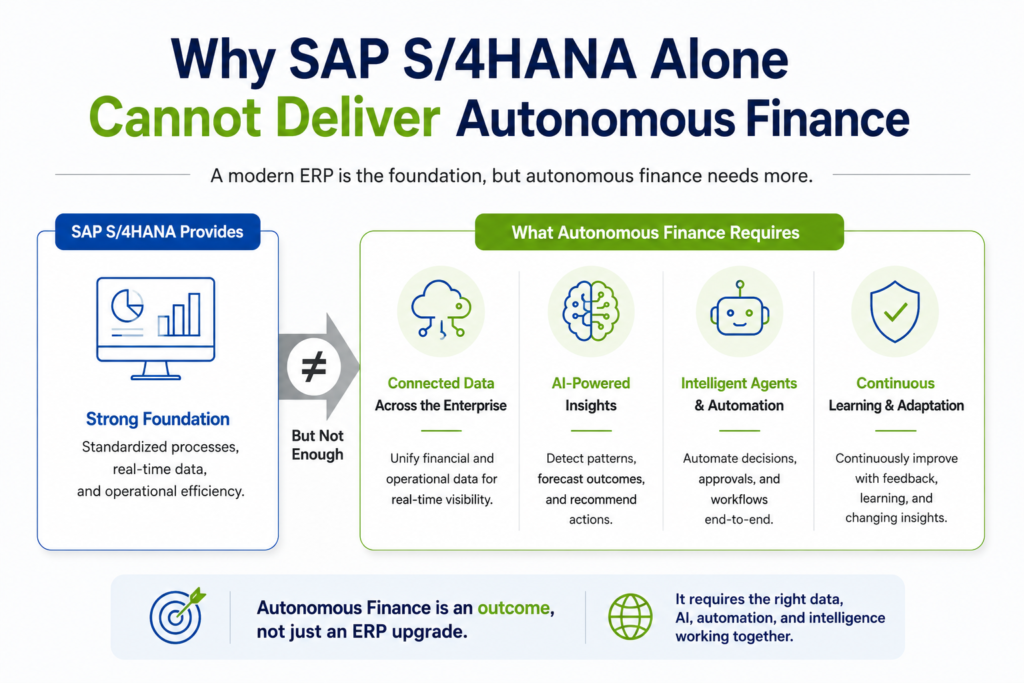
SAP combines enterprise applications, trusted business data, artificial intelligence, and intelligent agents to create autonomous finance operations.
Connects enterprise-wide financial and operational data.
Provides forecasting, anomaly detection, and intelligent insights.
Automate recommendations, approvals, and workflow execution.
SAP’s approach to sap ai finance combines several technologies working together across the enterprise.
SAP S/4HANA Finance
SAP S/4HANA Finance provides the transactional foundation for modern financial operations.
Key capabilities include:
- Real-time accounting
- Embedded analytics
- Universal Journal
- Integrated planning
- Financial reporting
SAP Business Data Cloud
Business Data Cloud brings together operational and financial information from across the organization, creating a trusted foundation for AI-powered decision-making.
SAP Analytics Cloud
SAP Analytics Cloud supports:
- Forecasting
- Scenario planning
- Predictive analytics
- Financial modeling
SAP Ariba and SAP Concur
Procurement and expense management solutions contribute valuable spend intelligence to the broader Autonomous Finance ecosystem.
SAP Enterprise Planning
SAP’s next-generation planning capabilities support a “sense-reason-act” model that connects real-time data with strategic decision-making.
Joule SAP Finance and Intelligent Agents
A key component of sap ai finance is Joule SAP Finance, which introduces AI assistants and intelligent agents directly into business workflows.
These assistants help eliminate manual work while improving speed and accuracy.
Accounts Payable Assistant
The Accounts Payable Assistant can:
- Validate supplier bank accounts
- Detect payment exceptions
- Recommend corrective actions
- Automate reconciliation activities
This reduces manual effort and improves payment accuracy.
Tax and Compliance Assistant
Tax teams face constant regulatory change.
The Tax and Compliance Assistant helps organizations:
- Monitor global regulations
- Identify compliance risks
- Generate recommendations
- Support audit readiness
These capabilities make Autonomous Finance solutions more proactive and responsive.
Cash and Treasury Assistant
The Cash and Treasury Assistant provides:
- Real-time liquidity visibility
- Cash flow forecasting
- Funding recommendations
- Treasury risk monitoring
Using Autonomous Finance AI, treasury teams can make faster and more informed decisions.
Autonomous Finance Examples
Many organizations are already implementing practical Autonomous Finance examples across finance operations.
Example 1: Accounts Payable Automation
A manufacturing company processes thousands of invoices every month.
AI agents can:
- Match invoices automatically
- Verify supplier information
- Detect anomalies
- Route exceptions
Results often include faster processing, reduced operational costs, and improved supplier relationships.
Example 2: Treasury Optimization
A multinational enterprise manages liquidity across multiple countries and banking partners.
Using Autonomous Finance AI, treasury teams can:
- Predict future cash positions
- Identify liquidity gaps
- Optimize fund allocation
- Reduce financing costs
Example 3: Tax Compliance Management
Organizations operating across jurisdictions face increasing regulatory complexity.
AI-powered compliance assistants can:
- Track regulatory updates
- Analyze exposure
- Generate alerts
- Recommend corrective actions
SAP AI Use Cases Across Finance
There are numerous SAP AI use cases transforming financial operations today.
Common examples include:
- Financial Close Automation: AI assists with reconciliations, journal entries, and exception management.
- Cash Flow Forecasting: Machine learning models predict future liquidity requirements using real-time business data.
- Spend Analysis: Organizations gain deeper visibility into spending patterns and procurement performance.
- Risk Management: AI identifies anomalies and potential financial risks before they impact operations.
- Budget Planning: Finance teams can model multiple business scenarios more efficiently.
These SAP AI use cases help organizations improve agility, efficiency, and financial control.
Autonomous Finance in SAP MM
Procurement decisions directly influence financial performance.
Within Autonomous Finance in SAP MM, AI-powered agents can:
- Monitor supplier performance
- Analyze purchasing trends
- Enforce contract compliance
- Identify cost-saving opportunities
- Reduce procurement risk
These capabilities help connect procurement and finance processes within the broader business suite SAP ecosystem.
Autonomous Finance in SAP ABAP
Many organizations require custom workflows and specialized integrations.
Autonomous Finance in SAP ABAP enables businesses to:
- Build custom AI extensions
- Integrate external AI services
- Create industry-specific automation
- Develop custom finance workflows
- Extend standard SAP functionality
ABAP continues to play an important role in delivering tailored Autonomous Finance capabilities.
SAP Finance and Spend Management
Modern enterprises require visibility across all spending activities.
SAP Finance and Spend Management solutions help organizations:
- Improve spend control
- Strengthen supplier collaboration
- Reduce procurement costs
- Increase financial transparency
- Improve approval processes
When combined with Autonomous Finance, these capabilities support more intelligent and proactive decision-making.
SAP Finance and Controlling in S/4HANA
Are SAP FICO and S4 HANA the same?
No.
SAP S/4HANA is SAP’s next-generation ERP platform, while SAP Finance and Controlling (SAP FICO) refers to the finance and controlling functionality within the platform.
In SAP S/4HANA, finance and controlling are unified through the Universal Journal.
Benefits include:
- Single source of truth
- Simplified reporting
- Reduced reconciliation effort
- Better financial transparency
- Real-time analytics
This makes SAP Finance and Controlling more integrated and efficient than traditional ERP architectures.
Which SAP is used in finance?
The primary SAP solution for enterprise finance is SAP S/4HANA Finance.
Organizations often deploy it through:
- RISE with SAP
- GROW with SAP
Many enterprises also adopt SAP Finance Premium capabilities to accelerate finance transformation initiatives and support advanced planning, analytics, and automation.
Governance and Control in Autonomous Finance
Many organizations want the benefits of AI while maintaining control over critical financial decisions.
SAP addresses this challenge through governed AI execution models that provide bounded autonomy.
Organizations can define:
- Approval thresholds
- Compliance requirements
- Risk controls
- Audit policies
- Human review checkpoints
According to SAP’s autonomous enterprise strategy, AI agents are designed to operate within governed business processes while maintaining appropriate human oversight for critical decisions.
This balance helps organizations achieve efficiency without sacrificing accountability.
Building an Autonomous Finance Roadmap
Organizations looking to adopt Autonomous Finance should follow a phased approach.
Phase 1: Establish a Digital Core
Implement SAP S/4HANA Finance and create a unified financial data foundation.
Phase 2: Improve Data Quality
Connect operational and financial systems through trusted business data.
Phase 3: Introduce AI-Powered Automation
Deploy assistants and agents for accounting, treasury, tax, and spend management processes.
Phase 4: Expand Predictive Capabilities
Use AI for forecasting, scenario planning, and risk analysis.
Phase 5: Scale Toward Autonomous Operations
Enable intelligent agents to execute approved business actions with governance controls in place.
The Future of Autonomous Finance
Autonomous Finance represents the next stage of digital finance transformation.
By combining SAP Business AI, Joule Agents, SAP S/4HANA Finance, Business Data Cloud, and real-time enterprise data, organizations can move beyond traditional automation toward intelligent, self-optimizing financial operations.
As SAP continues expanding its SAP autonomous enterprise strategy, Autonomous Finance will play a central role in helping organizations improve efficiency, strengthen compliance, optimize cash flow, and make better business decisions.
For finance leaders, the question is no longer whether AI will transform finance. The question is how quickly organizations can adopt Autonomous Finance to gain a competitive advantage in an increasingly data-driven business environment.
Start Your Autonomous Finance Journey with Quadric IT
As organizations move toward AI-driven finance operations, having the right strategy, technology foundation, and implementation partner becomes critical. At Quadric IT, we help businesses modernize finance processes through SAP S/4HANA, SAP Business AI, finance automation, analytics, and intelligent workflow solutions.
Whether you are exploring Autonomous Finance, optimizing financial planning, improving treasury visibility, or enhancing compliance and spend management, our team can help you build a practical roadmap aligned with your business goals. Connect with Quadric IT to discover how AI-powered finance can drive greater efficiency, control, and business value across your enterprise.