
Autonomous HCM in SAP
Companies face three constant pressures today. They must hire faster. They need to fix skill gaps. They have to keep teams productive.
Traditional HR software cannot solve these issues. Older platforms were built strictly as systems of record. They work like digital filing cabinets. They are designed to store historical data. They do not drive real-time results. A passive database cannot fix a bottleneck. It cannot optimize a team. It only records that a problem exists.
That model is changing. The rise of the autonomous enterprise is transforming Human Capital Management (HCM). It changes software from a tool that merely tracks work into an active system. This new system analyzes data, recommends paths forward, and executes tasks.
This is Autonomous HCM. It moves organizations away from manual tracking. It introduces intelligent systems that handle routine workforce operations. It requires minimal human intervention.
What Is Autonomous HCM?
Autonomous HCM shifts organizations from reactive administration to proactive workforce management. It relies on three core pillars: AI assistants, business data, and workforce intelligence.
Conventional workflow automation follows strict, pre-set rules. Autonomous HCM is different. It continuously monitors enterprise events. It understands operational context. It takes independent action when needed.
The system handles multiple critical tasks. It identifies immediate workforce gaps. It resolves complex payroll issues. It supports managers with hiring decisions. It also automates routine employee interactions.
The goal is not to replace human HR teams. Instead, it eliminates high-volume administrative work. This frees HR professionals to focus on workforce planning. They can dedicate time to employee development and high-level business strategy.
Difference Between HRIS and HCM
Understanding Autonomous HCM begins with understanding the evolution of HR technology.
- A Human Resources Information System (HRIS) is designed primarily to store employee records and support core HR administration. Typical functions include employee data management, benefits administration, attendance tracking, and payroll processing.
- Human Capital Management (HCM) is a broader approach that manages the entire employee lifecycle. In addition to core HR functions, HCM includes recruitment, onboarding, performance management, learning, workforce planning, succession planning, and employee development.
Modern HCM platforms connect people, processes, and business objectives through a single system, creating the foundation required for AI-driven automation.
This broader scope makes HCM platforms the foundation for AI-powered workforce automation and autonomous HR operations.
From SAP HCM to SAP SuccessFactors
The migration from SAP HCM to SAP SuccessFactors is a prime example of this technology shift.
SAP HCM represents the legacy system of record. It is an on-premise platform built to manage structured HR processes. It centralizes employee data and tracks basic compliance well. However, it relies heavily on manual inputs. It keeps workforce data trapped in passive, historical databases.
SAP SuccessFactors changes this model. It moves organizations into a cloud-based environment built for autonomous operations.
The core driver of this shift is Joule, SAP’s embedded AI copilot. Joule transforms SuccessFactors from a standard automation tool into an intelligent execution engine. Instead of waiting for human commands, the system uses autonomous agents to continuously analyze workforce intelligence. It proactively flags compliance risks, audits payroll data, and guides managers through complex hiring decisions.
Migrating to SuccessFactors is no longer just a cloud upgrade. It is a strategic move from a passive SAP database to an active, autonomous workforce infrastructure.
How SAP Is Enabling Autonomous HCM
Traditional software forces users to adapt to the system. An HR professional must log in, click through multiple sub-menus, pull data from separate modules, and manually piece together an answer. It is a slow, fragmented narrative.
SAP’s vision for Autonomous HCM completely flips this script. The entire ecosystem is built around Joule, a central intelligence layer integrated across all SAP applications.
Joule changes the story from menu navigation to conversational execution. It does not simply answer questions like a basic chatbot. Instead, it understands complex requests, gathers the necessary data, and coordinates actions across different HR processes in real time.
Every person in the company interacts with this single layer. Employees update profiles without filling out forms. Managers make immediate, data-driven hiring decisions. Recruiters screen candidates seamlessly, and payroll specialists audit compliance errors effortlessly. Rather than requiring users to open five different screens to complete one job, Joule acts as the coordinator—handling the background workflows so humans can focus on the final decision.
SAP is extending these capabilities through specialized AI assistants designed to support specific HR functions and workflows.
- Core HR Operations
AI assistants can monitor organizational structures, identify workforce gaps, and recommend position adjustments before issues affect business operations.
By continuously analyzing employee and organizational data, the system helps maintain accurate workforce structures while reducing manual administrative effort.
- Payroll Management
Payroll remains one of the most complex and time-intensive HR functions for many organizations.
Autonomous payroll capabilities can identify potential issues before payroll runs are completed, highlight exceptions, and guide administrators toward faster resolutions. This reduces delays, improves accuracy, and minimizes payroll-related risks.
- Time and Attendance
Time tracking often involves manual reviews, corrections, and exception handling.
AI-driven time management can automatically monitor attendance data, identify inconsistencies, and ensure that records are accurate before payroll processing begins.
- Recruiting and Onboarding
Recruitment involves multiple stakeholders, systems, and approval processes.
Autonomous HCM helps streamline candidate selection, interview coordination, onboarding activities, and employee transitions. By connecting recruiting and onboarding workflows, organizations can reduce delays and improve the new-hire experience.
What are the purpose-built Joule assistants for HCM?
SAP translates its Autonomous HCM strategy into practice through a suite of specialized, domain-specific AI tools. Built to run natively across SAP SuccessFactors, these assistants move beyond generic chat to manage specific, high-volume HR processes with full business context.
Some of the key Joule Assistants for HCM include:
Purpose-Built Joule Assistants for HCM
SAP's Autonomous HCM vision is powered by specialized Joule Assistants embedded within SAP SuccessFactors. These AI assistants automate routine HR work, improve workforce decisions, and help HR teams focus on strategic priorities.
Detects payroll issues and guides faster resolution.
Supports candidate screening and hiring workflows.
Simplifies employee onboarding and setup.
Answers HR questions and routes requests.
Maintains workforce data and compliance.
Automates attendance and timesheet management.
Recommends personalized learning paths.
Aligns workforce decisions with business goals.
Evaluates workforce structure scenarios.
Supports talent growth, succession, and retention.
Automates routine HR activities intelligently.
Provides AI-driven workforce recommendations.
Together, these capabilities represent a significant step toward truly autonomous HR operations, where routine work is executed intelligently and HR teams can focus on strategic workforce outcomes.
SAP HCM Automation Beyond Workflows
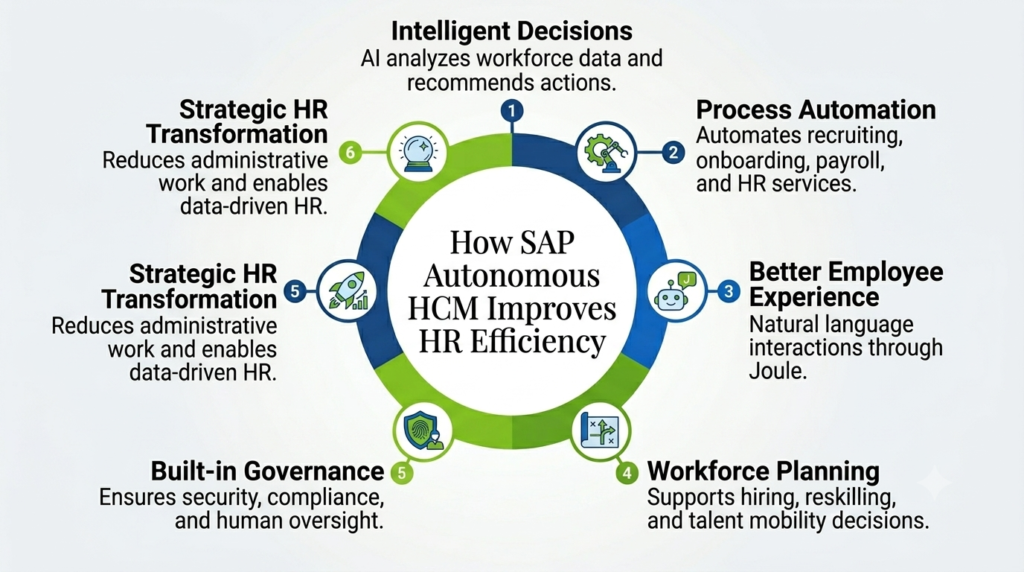
Earlier generation HR automation follows strict, pre-set rules. It can only do basic tasks. If something unexpected happens, the automation stops working. A human has to step in and fix it.
Autonomous HCM goes much further. It combines basic automation with real intelligence.
Imagine a global company running payroll across different countries. Sometimes, data gets messy or mismatched. This can delay employee paychecks.
With Joule and the Payroll Assistant inside SAP SuccessFactors, the software handles this automatically. The system spots data errors early. It finds the root cause of the mistake. It then fixes the issue or tells the payroll team exactly how to resolve it before payroll runs.
This changes the day-to-day work for HR teams. They no longer spend hours reacting to mistakes after they happen. Instead, the system fixes problems proactively.
Examples include:
- Detecting workforce shortages before they impact operations
- Identifying payroll discrepancies before payroll processing
- Recommending internal candidates for open positions
- Automating employee support requests
- Supporting workforce planning with predictive insights
This shift enables HR teams to spend less time on administration and more time on workforce planning and strategic decision-making.
Business Benefits of Autonomous HCM
Autonomous HCM delivers clear, measurable business value. It moves organizations far beyond simple task automation.
The software reduces everyday administrative effort. It improves payroll accuracy across the enterprise. It accelerates hiring timelines for open roles. It also strengthens long-term workforce planning.
Employees get immediate value too. They receive faster support for their daily questions. They also get access to personalized development opportunities.
By combining AI with workforce intelligence, HR teams change their daily focus. They spend much less time managing manual transactions. Instead, they can spend their time driving strategic business outcomes.
Why Autonomous HCM Matters
The ultimate value of Autonomous HCM is a fundamental shift in executive focus. It moves HR leaders from managing software operations to orchestrating enterprise strategy.
When day to day transactions run on self-executing intelligence, the organizational benefits scale across three strategic vectors:
- Capitalizing on Workforce Data: Instead of auditing historical reports to find out why turnover happened or why payroll failed, leaders leverage real time intelligence to prevent operational friction before it impacts the bottom line.
- Maximizing Human Capability: By absorbing high volume administrative tasks like resume screening and routine policy inquiries, the system frees HR professionals to focus on high impact initiatives like leadership development and workforce planning.
- Dynamic Operational Velocity: The enterprise gains the agility to adapt instantly to market shifts, organizational restructuring, and regulatory updates without breaking existing workflows or requiring manual system configuration.
The Strategic Takeaway: Autonomous HCM changes the role of enterprise software. It transforms SAP SuccessFactors from a passive system of record into an active strategic engine that keeps your people operations perfectly aligned with your broader corporate growth goals.
The Future of Human Capital Management
This architecture represents the next stage in enterprise evolution. Human capital management is moving beyond digital record keeping and basic workflow automation toward a model where intelligent systems are active participants in workforce operations.
As SAP expands its AI capabilities through SAP SuccessFactors and Joule, Autonomous HCM becomes a practical reality. As AI transitions from a passive assistant to an active participant, organizations that adopt these capabilities early will be uniquely positioned to build a truly future ready workforce.
Unlock the Value of Autonomous HCM
Autonomous HCM is no longer a future concept. It is the modern operational standard for enterprises to attract, manage, and develop global talent.
Quadric IT accelerates your transition to SAP SuccessFactors, eliminating manual processing bottlenecks and deploying intelligent workforce management natively. Speak with our consultants today to audit your current HR infrastructure and pinpoint immediate opportunities for autonomous automation and scalable business growth.