






SAP Business AI for core operations
How SAP Business AI moves supply chain, inventory, logistics and demand planning from reactive firefighting to proactive, data-driven decisions.
By Rajeswari Rao
SAP Business AI for core operations helps businesses gain better control over supply chain, logistics and inventory by using AI within existing SAP systems. Instead of reacting to disruptions after they occur, organisations can identify risks early, plan more accurately and make informed operational decisions.
Today’s business landscape demands unprecedented speed and precision. Yet core operations in supply chain, logistics and inventory management are often hampered by manual processes, siloed data and reactive planning. Teams struggle with volatile demand, costly delays and constant pressure to reduce working capital while maintaining perfect service. The gap between data and decisive action remains a persistent challenge.
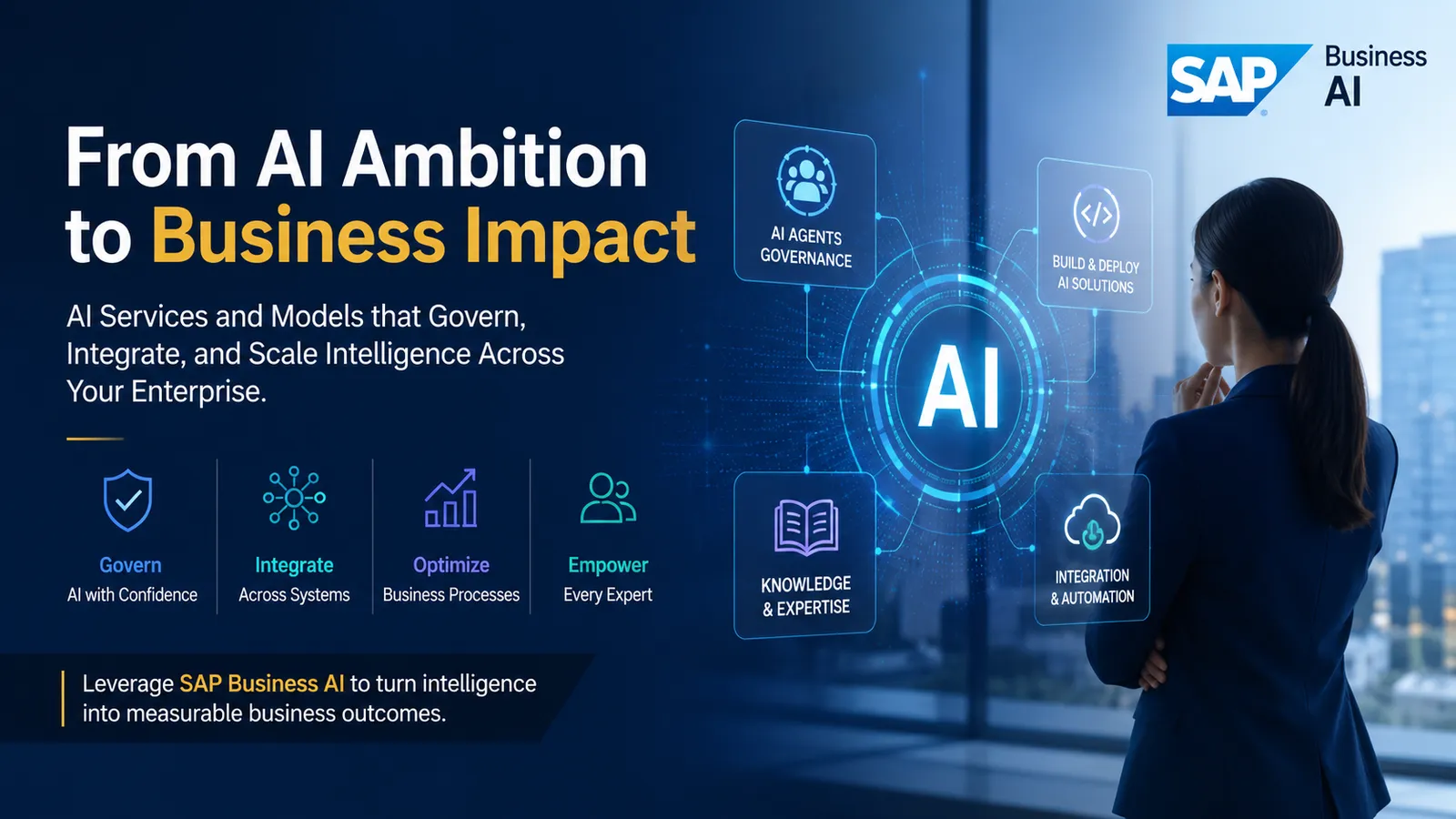
This is where artificial intelligence moves from buzzword to daily execution partner. SAP Business AI embeds directly into the transactional workflows of your existing SAP systems, turning them from systems of record into systems of intelligent action — from asking “what happened?” to proactively answering “what should we do next?”
What is SAP Business AI in core operations?
At its essence, SAP Business AI is the application of machine learning, predictive analytics and automation directly within SAP’s operational applications — such as S/4HANA, IBP, TM and EWM. Unlike a separate AI tool, it works inside your daily processes for supply chain (opens in a new tab), logistics and inventory management.
Think of it as an always-on co-pilot for planners, warehouse managers and logistics teams. It continuously analyses your transactional data (orders, shipments, stock levels) alongside external signals (market trends, weather, news). By identifying complex patterns and predicting outcomes, it provides data-driven recommendations and can even automate routine decisions — so teams spend less time searching for insight and more time acting on it.
Where AI improves day-to-day execution in SAP:
Supply chain planning
Inventory management
Logistics & transportation
Warehouse management
Demand planning
Supply chain planning
For SAP-centric organisations, moving from deterministic to intelligent planning requires more than a generic AI promise. It demands a clear understanding of how SAP’s AI capabilities are engineered into its supply chain platform, the architecture that enables them and the implementation pathway to value.
The core planning challenge
Many SAP ECC or S/4HANA environments rely on manual, Excel-based planning cycles outside the system, or on standard MRP that lacks predictive and probabilistic modelling. This disconnects the transactional system of record from the planning logic — leading to reactive adjustments, under-used advanced planning functions and plans that cannot absorb real-world volatility.
From data to prescriptive action
SAP Business AI integrates machine learning directly into the planning data pipeline — a layered capability within SAP Integrated Business Planning (IBP), extensible via SAP Business Technology Platform (BTP):
- Data unification
- SAP Datasphere harmonises internal time-series data from S/4HANA (sales, production) with external data such as market indices and weather APIs.
- Model execution
- Pre-built ML models native to SAP IBP (for demand) or custom models deployed on BTP AI Core analyse the unified dataset.
- Prescriptive integration
- Forecasts and risk scores populate key figures in the IBP planning model, directly influencing supply planning heuristics or optimiser runs.
Key SAP AI components
- SAP IBP Demand ML forecasting
- Out-of-the-box multivariate, pattern-based demand forecasting that automatically selects the best-fit statistical model.
- SAP IBP Response & Risk
- Runs simulation scenarios against a digital twin of the supply chain, powered by live planning data.
- Predictive analytics in SAP Analytics Cloud
- Predictive forecasting and smart insights embedded directly in analytical apps for planners.
- BTP AI Business Services
- Document Information Extraction and Business Entity Recognition automate the ingestion of unstructured data (supplier emails, news) into the planning model.
AI agents, predictive engines and generative interfaces
SAP Joule & embedded agents
Joule increasingly acts as a natural-language interface to the IBP planning workspace, while embedded intelligence re-forecasts at a defined frequency and alerts via the SAP Fiori launchpad when confidence intervals are breached.
The predictive AI engine
- Applications: multivariate demand forecasting, probabilistic risk simulation, predictive lead-time calculation.
- Mechanism: ML models in SAP IBP or on BTP AI Core analyse historical and external data to forecast outcomes and run what-if scenarios.
The generative AI interface
- Applications: natural-language explanations of forecast drivers, automated planning reports and alerts.
- Mechanism: Joule summarises planning insights and automates narrative creation, acting on predictive alerts.
Integration, deployment and impact
- Native integration (IBP Cloud)
- The most straightforward path, using SAP’s pre-delivered AI within IBP; the focus shifts to data pipelines and process design.
- Extensibility via BTP
- Custom ML in Python or R, containerised on BTP AI Core and consuming S/4HANA data via OData or event-driven APIs — where deep technical consultancy is critical.
- Data foundation
- AI efficacy is tied directly to the quality of master data such as product hierarchies and location definitions.
- Business impact
- Lower forecast error (MAPE), reducing the capital tied up in safety stock; planners shift effort from data preparation to analysis; planning (IBP) and execution (S/4HANA) form a closed loop.
Looking ahead: we anticipate Joule becoming a proactive planning agent rather than just a query tool, broader availability of pre-trained industry models in the SAP AI (opens in a new tab) foundation library, and tighter “plan-to-act” automation between IBP alerts and S/4HANA execution.
Intelligent inventory
Inventory optimisation is often constrained by the rigid parameters of classic MRP or simplified safety-stock models. Fixed safety stock, reorder points and planned delivery times cannot account for real-world variability — creating a constant tug-of-war between working capital tied up in buffer stock and stock-outs that disrupt production and sales.
- Variability analysis
- ML models in SAP IBP Inventory or on BTP analyse demand volatility and supply lead-time reliability for every material-location combination.
- Cost parameters
- Business-defined costs for carrying inventory, stock-outs and ordering are built into the model.
- Dynamic parameters
- Optimised, time-dependent target stock, safety stock and reorder points meet a specified service level — written back to S/4HANA or IBP.
- Key components
- SAP IBP Inventory Optimisation (multi-echelon safety stock), Advanced ATP with predictive analytics in S/4HANA, and custom optimisation on BTP AI Core.
- Joule in practice
- “For material XYZ at plant 1000, explain the drivers behind the recommended safety-stock increase and simulate a 95% vs 98% service level.”
- Business impact
- Lower overall inventory while maintaining or improving service levels, freeing working capital; monthly exception reviews give way to governed, system-driven optimisation.
Logistics & transportation
SAP Transportation Management (TM) is often used as a system of record rather than a system of intelligence. Planners build loads and select carriers by habit, with limited visibility into real-time rates, capacity or traffic — leading to suboptimal mode selection, low asset utilisation and reactive delay management. SAP Business AI moves logistics from post-execution freight audit to pre-execution optimisation and real-time predictive control.
- Intelligent load building
- AI in SAP TM or SAP Logistics Business Network proposes optimal load consolidation and containerisation, maximising equipment fill rates.
- Carrier & rate optimisation
- ML evaluates carrier performance, spot-market rates and service levels to recommend the best carrier for each lane and load type.
- Predictive delay management
- Tracking, weather and port-congestion data predict delays before they occur, triggering re-routing or customer notifications.
- AI agents
- Optimisation agents re-plan shipments as conditions change; alerting agents trigger exception workflows or Fiori notifications when predicted delays exceed a threshold.
- Business impact
- Lower freight spend through higher load factors and better carrier choice, fewer detention and demurrage costs, and proactive shipment updates for customers.
Smarter warehouses with SAP EWM
Even with SAP Extended Warehouse Management, task interleaving, pick paths and labour allocation are often rule-based and static. SAP Business AI adds a cognitive layer — from goods receipt to fulfilment — turning the warehouse into an adaptive hub that optimises for multiple, changing objectives.
- Dynamic slotting & replenishment
- ML analyses pick frequency, velocity and product affinity to recommend storage locations and trigger just-in-time replenishment.
- Cognitive wave & task management
- AI evaluates the live order pool, resources and equipment to create waves and task sequences that minimise travel and balance labour.
- Vision & voice
- Computer vision automates goods-receipt verification; AI-driven voice picking adapts instructions to worker location and congestion.
- AI agents
- A real-time dispatcher re-sequences warehouse tasks when conditions change; a labour agent forecasts staffing from inbound deliveries and sales orders.
- Business impact
- More picks per hour, shorter travel, fewer mis-picks — and a framework ready for autonomous mobile robots and smart wearables.
AI-powered demand planning
Demand planning is the foundational input for every operational plan. Traditional forecasting often runs in a silo, disconnected from promotions, events and market data, so planners spend their time on manual overrides. SAP Business AI turns it into a self-learning, causal forecasting system integrated with S/4HANA and IBP.
- Unified data foundation
- SAP Datasphere brings together sales history, promotional calendars, events and external datasets such as GDP and weather.
- Causal forecasting
- SAP IBP Demand or SAP Analytics Cloud Predictive Planning tests multiple models and quantifies the impact of price, marketing spend or holidays on demand.
- Bias detection
- The system detects persistent planner overrides, learns from them and asks for the rationale behind new causal factors.
- Joule for demand
- “What were the top three drivers for the forecast increase in EMEA, and what is the confidence interval?”
- Business impact
- Higher forecast accuracy that flows into inventory and service levels, a governed audit trail of overrides, and tighter alignment between sales, marketing and supply chain.
The SAP BTP foundation
These capabilities run on a unified technical foundation: SAP Business Technology Platform. It lets businesses consume pre-built intelligence, extend SAP applications and build custom AI scenarios — all within the governance and data context of the SAP ecosystem.
SAP AI Core & AI Launchpad
Runtime and cockpit for deploying, operating and monitoring custom models that consume SAP data.
SAP HANA Cloud ML
Train and run machine learning inside the in-memory database for real-time predictive scenarios.
Pre-trained Business AI services
Document Information Extraction, Business Entity Recognition and Service Ticket Intelligence.
SAP Joule
The generative AI copilot tuned to SAP’s data model and processes, accessible through a consistent API.
- Embedded
- AI pre-integrated in SaaS applications such as IBP Cloud, SuccessFactors and S/4HANA Cloud Public Edition.
- Side-by-side extension
- Custom AI on BTP AI Core reads S/4HANA data via OData and CDS views and writes results back — for example a predictive maintenance score on the equipment master.
- Process automation
- SAP Build Process Automation adds AI services such as document extraction to end-to-end workflows across SAP and non-SAP systems.
For CIOs and enterprise architects, SAP Business AI on BTP consolidates AI efforts — reducing the complexity, cost and governance risk of disparate point solutions, and keeping AI insight grounded in the single source of operational truth in S/4HANA.
The path to an intelligent enterprise
SAP Business AI is a shift from process automation to cognitive augmentation in core operations. The value is not in the algorithms alone but in their careful integration into your data models, transactional workflows and user experience. That takes a partner with deep SAP technical architecture expertise, practical AI and ML deployment experience, and the business judgement to turn capability into measurable outcomes.
Quadric IT works at exactly this intersection. We help organisations define a pragmatic SAP AI roadmap, architect the BTP foundation and implement prioritised use cases like those above.