
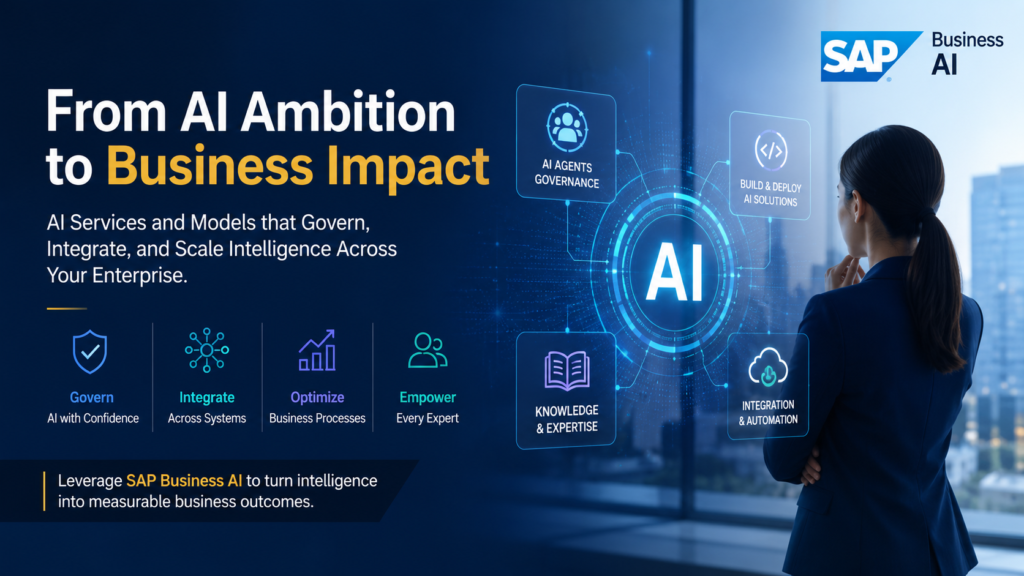
SAP AI Services and Models are becoming increasingly important as organizations look to move beyond AI experimentation and focus on measurable business outcomes. While enterprises have access to powerful AI technologies, many still struggle to scale adoption, govern AI effectively, and connect intelligence to real business processes. The challenge is no longer about accessing AI capabilities. It is about turning those capabilities into operational value.
Artificial intelligence has quickly moved from innovation labs into boardroom discussions. Organizations are investing heavily in AI to improve productivity, automate operations, strengthen decision-making, and create new business opportunities. Yet despite growing investment, many enterprises are finding it difficult to move beyond pilot projects and isolated use cases.
The challenge is not a lack of AI technology. Today’s organizations have access to powerful large language models, advanced machine learning capabilities, and a growing ecosystem of AI tools. The real challenge is turning those capabilities into measurable business outcomes.
As enterprises mature in their AI journey, a clear trend is emerging. Success is no longer determined by access to the best AI models. It depends on how effectively organizations can govern, integrate, scale, and operationalize AI across the business. This is where AI services and models are becoming critical.
Why SAP AI Services and Models Matter for Enterprise AI
The first phase of enterprise AI focused on experimentation. Organizations explored chatbots, predictive analytics, automation tools, and generative AI applications to understand the technology’s potential.
The next phase is fundamentally different.
Business leaders are no longer asking whether AI can generate content or answer questions. They are asking whether AI can improve forecasting accuracy, reduce operational costs, accelerate service delivery, strengthen compliance, and support better business decisions.
This shift changes the conversation from technology adoption to business execution.
Many organizations already have AI strategies in place. However, relatively few have successfully embedded AI into everyday business operations. The gap between strategy and execution remains one of the biggest challenges facing enterprises today.
The Problem with an AI-First Mindset
Much of the discussion around AI has focused on models. New foundation models, larger parameter counts, and improved performance benchmarks continue to dominate headlines.
While these advancements are important, they can create a misleading perception that better models automatically lead to better business outcomes.
In reality, models represent only one component of enterprise AI.
An AI model can generate recommendations, summarize information, and automate tasks. However, it cannot independently understand organizational structures, business processes, governance requirements, compliance obligations, or operational priorities.
Without business context, even the most advanced AI model can produce limited value.
This is why many organizations are discovering that successful AI adoption requires far more than model selection.
Why Models Alone Cannot Deliver Business Value
For AI to create meaningful business impact, it must operate within the context of the enterprise.
That means connecting AI to:
-
- Business processes
-
- Enterprise applications
-
- Operational workflows
-
- Governance frameworks
-
- Security policies
-
- Trusted business data
When these elements are missing, organizations often encounter familiar challenges:
-
- Inconsistent outputs
-
- Limited user adoption
-
- Security concerns
-
- Compliance risks
-
- Difficulty scaling beyond pilot projects
-
- Unclear return on investment
The future of enterprise AI depends on solving these challenges through a combination of AI models and AI services.
While models provide intelligence, AI services provide the structure required to deploy, manage, and scale that intelligence across the organization.
The Rise of AI Services and Enterprise AI Platforms
Organizations are increasingly recognizing that enterprise AI requires a supporting operational layer.
This layer includes services that help govern AI usage, connect models to business systems, manage knowledge, enforce security controls, and monitor performance.
Rather than treating AI as a collection of standalone tools, businesses are beginning to view AI as part of a broader enterprise ecosystem.
This shift is driving demand for capabilities such as:
-
- AI governance and oversight
-
- Agent lifecycle management
-
- Knowledge grounding
-
- Business process integration
-
- Model orchestration
-
- Identity and access management
-
- Observability and performance monitoring
These services help organizations move from isolated experimentation to sustainable AI adoption.
The Building Blocks of Enterprise AI
As enterprise AI matures, organizations need more than standalone models. They need a connected ecosystem of services that supports governance, development, deployment, knowledge management, and business process integration. SAP’s Business AI portfolio reflects this shift by providing capabilities designed to address different stages of the enterprise AI journey.
Key SAP AI Solutions Supporting Enterprise AI Adoption
As organizations scale AI initiatives, they need capabilities that support governance, development, integration, and knowledge management. SAP's Business AI portfolio addresses these critical areas of enterprise AI adoption.
SAP AI Agent Hub
- Centralized AI agent governance
- Agent discovery and lifecycle management
- Identity and access controls
- Architecture visibility and observability
Joule Studio
- Build and deploy AI agents faster
- Ground AI in business context
- Lifecycle management and monitoring
- Unified AI development environment
SAP Joule for Consultants
- Custom knowledge grounding
- Expert workspaces and prompt libraries
- Landscape-aware recommendations
- Faster project delivery and implementation support
SAP Integration Suite
- Connect SAP and third-party applications
- API management and governance
- LLM and AI connectivity
- Secure enterprise-wide integration
Four Challenges Every Enterprise Must Solve
Governance
As AI becomes embedded across business functions, organizations need visibility into how AI is being used, what data it accesses, and how decisions are being made.
Without governance, AI can introduce operational, regulatory, and security risks.
This growing challenge is driving interest in solutions that provide centralized visibility and control. Platforms such as SAP AI Agent Hub reflect this broader industry trend by helping organizations manage AI agents, understand dependencies, and strengthen governance across the enterprise.
Data
AI is only as valuable as the information it can access.
Organizations must ensure that AI systems are grounded in accurate, relevant, and trusted business data. Poor data quality continues to be one of the most significant barriers to successful AI adoption.
The focus is increasingly shifting from model performance to data readiness.
Integration
Many AI initiatives struggle because they operate outside existing business processes.
To create meaningful value, AI must connect directly with enterprise applications, workflows, and operational systems.
Organizations are therefore investing in platforms that simplify development, integration, and deployment. Solutions such as SAP Joule Studio illustrate how businesses are reducing complexity by bringing AI development, deployment, and enterprise connectivity together within a unified environment.
Expertise
Successful AI initiatives require specialized knowledge that often exists across multiple teams, business units, and external partners.
Capturing and scaling that expertise has become a strategic priority.
Knowledge-grounded AI systems are helping organizations transform institutional knowledge into reusable assets that support decision-making, implementation, and operational consistency.
This trend is particularly relevant within consulting and transformation environments, where platforms such as SAP Joule for Consultants demonstrate how AI can help scale expertise and accelerate project delivery.
What Business Leaders Should Focus on Next
As enterprise AI adoption accelerates, leaders should avoid viewing AI as a standalone technology initiative.
Instead, organizations should focus on building a sustainable AI foundation.
This includes:
-
- Establishing Governance Early
Governance should be built into AI initiatives from the beginning rather than added later.
-
- Prioritizing Trusted Data
Reliable business outcomes depend on reliable business information.
-
- Integrating AI into Core Operations
AI should support existing processes and workflows rather than operate separately from them.
-
- Measuring Business Outcomes
Success should be evaluated through operational improvements, efficiency gains, productivity improvements, and business value creation.
-
- Building for Long-Term Scale
Organizations should create frameworks that support future growth, evolving business requirements, and continued AI innovation.
Final Thoughts
The next generation of enterprise AI will not be defined by who has access to the largest models or the newest tools.
It will be defined by who can connect AI to business context, operational processes, governance frameworks, and trusted data.
AI services and models are becoming the foundation of this transformation. Together, they provide the intelligence, structure, and scalability organizations need to move from experimentation to execution.
For business leaders, the opportunity is clear. The future of AI is not simply about deploying smarter technology. It is about building smarter enterprises.
How Quadric IT Can Help
Successful AI initiatives start with a clear business objective. Whether your organization is looking to reduce operational inefficiencies, improve forecasting accuracy, automate repetitive tasks, strengthen customer engagement, or gain deeper insights from enterprise data, the right strategy matters as much as the technology itself.
Quadric IT helps organizations leverage SAP Business AI solutions to address real business challenges through intelligent automation, AI-powered insights, process optimization, and enterprise-wide transformation initiatives. By combining SAP expertise with deep process understanding, we help businesses move from AI experimentation to measurable business value.
What business challenges are you looking to solve with AI? Let’s explore how SAP Business AI can help turn those goals into practical outcomes.